Boiler Servicing & Maintenance in Vancouver
Annual boiler service keeps your system efficient, safe, and running through every Vancouver winter.
A boiler that gets annual servicing lasts longer, runs more efficiently, and is less likely to fail on the coldest day of the year. The opposite is also true: a boiler that never sees a service technician slowly degrades — efficiency drops, components wear without correction, and small problems compound into expensive failures.
Annual boiler servicing in Vancouver should happen before the heating season — late summer or early fall. By the time November hits and everyone's system starts up, the busy season for emergency calls begins. Getting your service done in August or September means your boiler is tuned, inspected, and ready before the cold.
We connect Vancouver homeowners with certified technicians who perform proper, thorough boiler service — not a 20-minute "check" that skips the combustion analysis and calls it done.
What Boiler Servicing & Maintenance Involves
Combustion Analysis
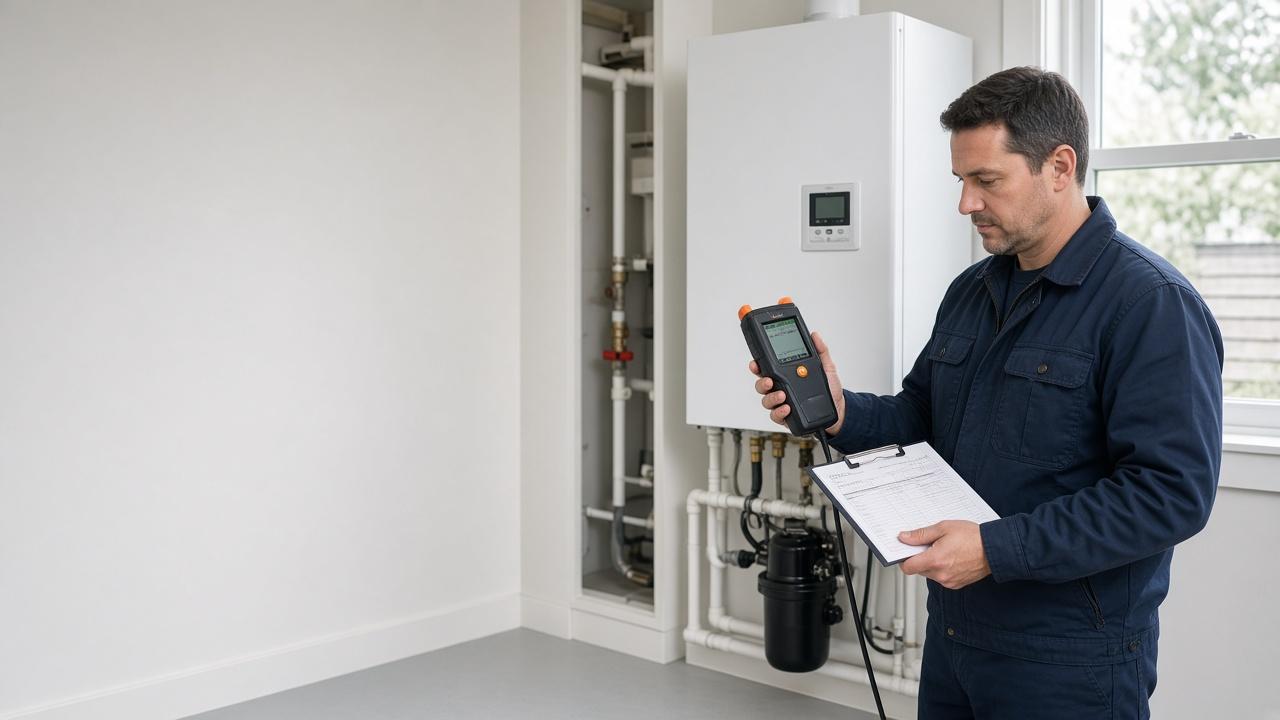
Using a calibrated Testo or equivalent flue gas analyser, we measure CO₂, O₂, CO, flue temperature, and efficiency at the appliance. Combustion drift occurs over time as the heat exchanger accumulates deposits and burner components age. Analysis identifies drift early, before it affects safety or efficiency.
Heat Exchanger Inspection & Cleaning
We visually inspect the heat exchanger for cracks, corrosion pitting, and sooting. On units with accessible heat exchangers, we clean burner passages with appropriate brushes and compressed air. A fouled heat exchanger reduces efficiency and increases the risk of CO production.
Pressure Relief Valve Test
The pressure relief valve is the safety device that prevents boiler over-pressurisation. We manually trip-test the PRV to verify it lifts and reseats correctly. A PRV that won't trip or won't reseat is a safety hazard and needs immediate replacement.
Expansion Vessel Check
The expansion vessel manages pressure changes as the system water heats and cools. We check the vessel's nitrogen pre-charge pressure against the manufacturer spec. A failed diaphragm causes repeated pressure relief valve weeping and is the most common cause of boilers 'over-pressurising' on heat-up.
System Flush & Water Chemistry
In older systems or those showing signs of corrosion, a power-flush or chemical flush removes magnetite sludge and debris from the distribution piping and heat exchanger. We also check system pH and inhibitor levels — proper inhibitor concentration significantly slows internal corrosion.
Controls & Safety Limit Check
We verify operation of high-limit controls, low-water cutoffs (on appropriate systems), and zone controls. Thermostats are checked for calibration. Outdoor reset curves are verified and adjusted seasonally if needed.
Technical Details
Optimal combustion for a natural gas boiler: CO₂ 8–10%, excess air 10–20%, CO under 50 ppm (air-free). Readings outside these ranges indicate a tuning or component issue.
Expansion vessel pre-charge pressure should equal system fill pressure (typically 12–15 psi cold for residential systems). Nitrogen pressure that drops below fill pressure means the diaphragm has failed.
System water pH should be maintained between 7.0–8.5. Outside this range, corrosion rates increase. Fernox or equivalent inhibitor should be maintained at manufacturer-recommended concentration.
A dirty flame sensor reads false low-ionisation and causes intermittent lockouts. Cleaning with fine steel wool restores correct signal in most cases — replacement is needed if cleaning doesn't restore the reading.
Annual flue inspections catch mortar joint failures in masonry chimneys and liner perforations in flex-liner systems that can cause CO spillage.
Frequently Asked Questions
How often should a boiler be serviced in Vancouver?+
Does servicing a boiler affect the warranty?+
What's included in a standard boiler service?+
When's the best time to get a boiler service in Vancouver?+
Boiler Servicing & Maintenance Across Greater Vancouver
Vancouver Boiler Installation Co provides boiler servicing & maintenance services across the entire Lower Mainland. Whether you're in Vancouver proper, Burnaby, Richmond, or out to Langley and Maple Ridge, we connect you with a certified technician in your area.